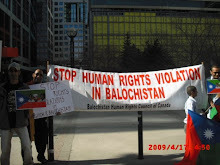
Stop the genocide of Baloch in Iran and Pakistan

My Blog List

Wednesday, June 2, 2010

BHRC calls upon the international community to intervene immediately in Balochistan againt the recent atrocities by Pak Army.


URGENT PRESS RELEASE
Toronto, June 1, 2010 – Baloch Human Rights Council (Canada) expressed its deepest concerns over the new wave of gross human rights violations committed by the Pakistani army soldiers in the Makaran region of Balochistan. BHRC has learnt through local sources and press statements of Baloch National Movement (BNM) central leadership that within the last couple of days there has been a significant movement of Pakistani troops in the area of district Gwadar and Dasht. A heavy contingent of military including 80 trucks carrying soldiers, 40 armoured vehicles, artillery, 8 gunship helicopters, and 20 water supplying tankers are reportedly part of the first wave of troop deployment in the region. There is news of more troops on the way to join the military operation.

Sources have confirmed that the Dasht townships of Zaren Bog, Mollai Negwar, Palani Bazaar, Ziarati, Hasadeg, Hor, Chateg, Doro Kandag, and the surrounding villages and tent settlements are under siege by the army. Reports coming in from the area stated that the soldiers have complete control of the meager water resources and have blocked all access to the local population. The livestock has been confiscated in the service of the soldiers and a large number was slaughtered to starve the inhabitants. Sources mentioned that people are not allowed to leave their homes even in case of a medical emergency.

There have been reported incidents of artillery fire directed at the civilian residential areas while gunship helicopters hovered over the towns. According to witnesses, incidents of aerial bombardment of villages have taken place and the fear of casualties is growing, complicated by the military blockade and denial of access to media and medical personnel. An unconfirmed number of youth has been taken away by the soldiers and their whereabouts are yet unknown. So far, names of two abducted persons have been confirmed, which are Mr. Sadiq Ismail, resident of Bal Negwar near Turbat and Mr. Shehak, resident of Gwarag.

BHRC urgently appeals to all international human rights bodies, the U.N., the European Parliament, the international media, and the world community to take urgent notice of the atrocities committed by the Pakistani army against innocent civilians in Dasht, Makaran and elsewhere in Balochistan. The slow motion genocide of the Baloch nation has to be stopped immediately by forceful intervention of world bodies.

Dr. Zaffar Baloch
President,
BHRC (Canada)

Thursday, May 27, 2010

No More Islamic Nuclear Bombs


By Imtiaz Baloch
Pakistan is the country that gives national security experts around the world nightmares. Pakistan is a country with an unstable and irrational history- Pakistan is a country that harbors Al-Qaida and its radical Islamic cells- Pakistan is a country with a notorious intelligence service which pampers Taliban- Pakistan is a country whose army's very anthem is to become the mercenary of the Islamic world right from the River Neil to Kashagar(Uyghur) China. It’s a country whose notorious nuclear missiles are named after the Islamic invaders who came from Central Asia to invade India. And if you want to put some more spice into this, it's a country with a nuclear arsenal. The security of this nuclear arsenal is one nightmare, the using of these nuclear on the nonbelievers and non Muslims is another suffocation and walmartizing and retailing of these nuclear arsenals to the rogue counties like Iran, North Korea and Libya is an imminent material danger to the world peace.
Abdul Qadir Khan, the father of the Pakistani Islamic nuclear bomb and a close friend to Ahmadi Nejhad and the notorious ISI, while running Pakistan’s nuclear programme, became a millionaire by selling atomic secrets to Libya, Iran and North Korea. He also used a network of companies in America and Britain to obtain components for a nuclear programme. As per Time magazine, in the early 2000, Qadir Khan caused an alert among western intelligence agencies when his aides met Osama Bin Laden. Sources confirmed that Saudi Arabia, that provides ideological premises to the radical Islam, has financed this Nuclear bomb and is the only country that is allowed to make frequent visit to Pakistan hidden nuclear sites.
Beside all of the above Islamic adventures of Pakistan Army, these atomic blasts had left permanent scars on Baloch history. It was Twelve years ago on May 28, 1998 when peace in the Pakistani occupied Balochistan was brutally shattered with a nuclear blast. The Islamic fundamentalists and their uniformed brethren, the Pakistani army, rejoiced the testing of the first Islamic bomb. The foreign minister of the Islamic Republic of Iran sent his greetings to the Pakistani government of the time while the world leaders were shocked and pleaded for sanctions against Pakistan.

This event was followed by further tests in the Chagai district of Balochistan devastating all life form including the livelihood of the nomadic Baloch tribesmen who were forced by the army to leave their ancestral lands to roam the deserts with their herds and tents. The physical and psychological effects on the people of Chagi Balochistan where these atomic test occurred are limitless, both in scope and time. After the nuclear blast, at miles, several people were burnt; people bled, people blinded, their burnt dead bodies were confiscated by the local Army Chief and declared that they died in heat, but very next day people found several burnt dead bodies of camel, as if camel dies in heat too.

In the last twelve years, Balochistan has become Pakistan’s frontline testing ground for advance nuclear warhead carrying missile technology borrowed from China and North Korea. The WMDs being developed in Pakistan today are part of the Chinese hegemonic design of expansionism in the region to control the energy centers, which include the Deep Sea Port Development of Gwadar in Balochistan, the gateway to oil and gas reserves in Central Asia and the Middle East. The local inhabitants of Balochistan are being forcefully displaced and slaughtered through a brutal military operation so that their resources and land stays in the hands of the Pakistan Army for exploitation and military adventures.

Islamic Republic of Iran's threat to world peace is far more than a mere rhetoric. Islamic Republic of Iran’s continuous effort to possess the capability to enrich uranium to the level needed for military purposes and Pakistani Army’s secret help in passing the Nuclear Technology is an imminent fact. This time it will be Islamic Republic to test its nuclear capability, and the venue will be Iranian Occupied Balochistan. The world will just accept this Nuclear Iran as a brutal reality as they did with Pakistan.
Today the temperatures had plunged by about 2 degrees Fahrenheit (1.25 degrees Celsius) over a large area in Chagi District, the faces of inhabitants have turned pale, women giving birth to blind children, people are dying of unknown diseases, the whole area had been contaminated. No independent study has been conducted to calculate the disastrous consequences of this catastrophe caused by this Islamic Bomb. This is the day when rest of Pakistan is on street rejoicing the Atomic Bomb but eyes of Baloch is full of tears and Baloch mourns today.

Sunday, May 9, 2010

THERE CANNOT BE JUSTICE WITHOUT FREEDOM


Dr. Zaffar Baloch, the president of BHRC, has delivered his speech in a conference called “Mining (in)justice: at home and abroad” organized by Community Solidarity Response Toronto (CSRT), it has being held in Toronto-Canada from May 7-9, 2010 at the Earth Sciences Building – University of Toronto.


THERE CANNOT BE JUSTICE WITHOUT FREEDOM

There cannot be a human rights violation greater than the enslavement of a people. All the categories of rights and freedoms are lost or snatched away with a single stroke. Such is the plight of Baloch and other stateless nations, subjugated by colonial powers in the past centuries, our forced acculturation, and our annexation into alien political states. The process of loss of nationhood and its rightful place in the world community is a painful experience that lives on in our collective memories. Independence for the Baloch people cannot be simply related to the nation’s socio-economic development, it also addresses the very core question of survival as an historical entity.

Multinational corporations such as Barrick Gold, Tethyan Copper and Antofogasta Minerals have signed agreements for exploration and mining in Balochistan with the new colonizers based in Islamabad, turning a blind eye at the gross human rights violations committed by the state forces against the indigenous Baloch people struggling for sovereignty over their land and resources. The greed for power, gold, and vast deposits of oil and gas is turning Balochistan into a killing field fueled by the decades of political turmoil within the province and in bordering Iran and Afghanistan. It is a common practice of the international companies to sign deals with the military dictators in Pakistan for larger share of profits and convenient terms of agreement. The former military ruler, retired General Pervez Musharaf who introduced Barrick Gold in Balochistan is not just another dictator but actually holds the title of “butcher of Balochistan” for the atrocities he has committed in the nine years of his rule. In a public speech, broadcasted live by the state television and radio, General Musharaf, then President of Pakistan, threatened the people of Balochistan and said, “You won’t even know what hit you.” And he kept his word.

Reko Dik, the area where Barrick Gold has been granted lease of land for mining holds world’s fifth largest copper and gold deposits. This site alone, according to reports, has an estimated 12.3 million tons of copper and 20.9 million ounces of gold now sold to the international companies for US$ 21 billion. Rough estimates suggest that the gold and copper at the surface accounts for US$ 65 billion worth of deposits. And Pakistan’s total national debt is actually is lesser and stands at US$ 38 billion. The final document of agreement between Barrick Gold and Antofogasta was signed in February 2006 under General Musharaf’s military rule and in August 2006 Nawab Akbar Bugti, former Chief Minister and Governor of Balochistan, and one of the most significant Baloch politician and leader of the resistance movement was killed after days of aerial bombing by gunship helicopters. Indeed, dictator Musharaf kept his word. However, only two years after the signing of this agreement, Balochistan’s sitting Chief Minister Nawab Aslam Raisani cancelled the lease of land to Barrick Gold. Chief Minister Balochistan said, “This agreement was against the wishes of the people of Balochistan.”

Militarization and mining in Balochistan go hand in hand. At present, there are four mega military cantonments, 52 paramilitary cantonments, five naval bases, and six missile-testing ranges in Balochistan. The first nuclear test conducted by Pakistan on May 28, 1998 was in Ras Koh Mountain, merely 15 miles from Reko Dik where Barrick Gold is involved in exploring copper and gold. The second and third nuclear devices were tested in the same area of district Chaghai only 60 miles from Reko Dik. Just imagine the devastation already done by the nukes that will be further complicated by the pollution caused by cyanide and arsenic used in mining. As for any kind of impartial investigation to measure radioactivity in the area or pollution caused by mining – the military has declared it a “sensitive strategic zone” where civilians are not permitted to enter. Therefore, the whole Barrick Gold saga in Balochistan is hidden under a thick military blanket with maximum protection. In fact, a testimony of a local physician was published by a foreign journalist on March 3, 2010. The doctor told the interviewer that following the nuclear tests, three scorched bodies of local shepherds were found in the wilderness. The police took charge of the bodies and stated that the cause of death was heat stroke. Next day, reports came in of several dead camels in the same vicinity and nobody believed that a camel could die from heat.

And if you think that the nuclear tests and copper and gold mining in Reko Dik are not enough to pollute the land of district Chagai in Balochistan, welcome to Saindak copper and gold project, located 189 miles from where Barrick Gold is digging for gold. Saindak project is a Chinese investment who now is also interested in buying Reko Dik mining lease after the cancellation of the agreement with Barrick Gold. Negotiations are underway between China’s state owned Metallurgical Group and Islamabad. Since, this Chinese company is already developing the Saindak copper and gold project and China being the largest supplier of military hardware to Pakistan after the US, this could possibly materialize with the blessings of Pakistan’s Chief of Army Staff, General Ashraf Kayani.

District of Chagai in Balochistan is 50,545 sq Km with a population of 250,000 according to a 2005 estimate. Chagai is an arid zone and faces acute shortage of water. Like the Saindak project, the expected mining operations in Reko Dik will depend on sub-surface water mainly used by local inhabitants for personal usage and for their animals and farming. The local natural resources of water seem barely enough to sustain life in the area and to support the operation of two copper and gold mining projects, a large quantity of water needs to be fetched from far off places and stored in reservoirs. At present the Saindak project is supplied water from a dam, which is located approximately 2 miles from the site. There are plans to build another dam for Reko Dik about 48 miles from the mines. It seems that the state of Pakistan wants to make sure that in case the people of Chagai survive radioactive and chemical pollution, they should certainly die of thirst.

To sum up the ordeal of the people of Chagai and the rest of Balochistan; there is an ongoing brutal military operation, 250,000 have become internally displaced, torture and extrajudicial killing of activists is common, more than 8000 have been forcefully disappeared by the security forces, and there is no salvation from being crushed by the state’s military on one hand and by the so-called mega development projects on the other. People of Balochistan do not seek justice from the state any more because they expect none. Today, after decades of struggle and hardships, the Baloch nation is beginning to realize from their collective experiences of history that ‘there cannot be justice without freedom’.

Monday, May 3, 2010

US diplomat meets Khan of Kalat family


According to a Pakistani News paper the Karachi-based US Consul General Stephen G Fakan has met some family members of Khan of Kalat Mir Suleman Daud in Kalat Town.

This was the first meeting of any US diplomat with the family members of Khan of Kalat who was in self-exile in London for the last four years.

According to sources, the prevailing situation of Balochistan also came under discussion during the meeting. It may be mentioned that Khan of Kalat had not only convened an important jirga of Baloch tribal elders after the assassination of Nawab Akbar Khan Bugti but he had also left the country.

Some sources claimed that attempts were made on behalf of some important personalities to bring Khan of Kalat back to Pakistan but so far these efforts have not succeeded.
Khan of Kalat had also rejected any negotiations with the govt without presence or assurance of international guarantors.

Political observers were attaching great importance to the meeting of a senior US diplomat with the family members of Khan of Kalat. However, it could not be known whether this was a courtesy call or any attempt on behalf of some foreign diplomats for improvement of situation in Balochistan because US and its allies were considering peace in Pakistan indispensable for their success in war against Taliban in Afghanistan.

http://www.nation.com.pk/pakistan-news-newspaper-daily-english-online/Islamabad/02-May-2010/US-diplomat-meets-Khan-of-Kalat-family

BHRC condemns spraying acid on the faces of three Baloch girls


Baloch Human Rights Council Canada condemn the heinous act of spraying acid on the faces of three Baloch girls in which Sakina, Saima and Fatima suffered serious burn injuries. According to the eye witnesses the girls were on their way from Babu Mohela to Khel town in Kalat when unknown people riding on a motorcycle threw acid on their faces. The sources told BHRC that two victims are reported to be serious. This is the second consecutive act of brutality against Baloch women in one month. Last month, in Dalbandin District, acid were thrown on womens' faces.

BHRC believes that Pak Military, FC, and Military Intelligence are engaged into a conspiracy against Progressive Baloch National Struggle.

BHRC also condemns the Pakistani intelligence agencies of distributing pamphlets where all the Baloch women were asked to stay home, in the name of a fictitious organization to create panic among women and defame the Progressive Baloch National Struggle.

BHRC demands to the international human rights organization to intervene and take serious notice of these heinous crimes against humanity.

Thank you
BHRC Canada

Friday, April 30, 2010

Baloch Community in London condemnation statement against throwing acid on Baloch girls

Leaders and activist of Baloch Community in London strong condemned the pro Taliban Pakistan’s intelligence and their agents for attacking Baloch girls with acids second time in the gap of a week. They said splashing acids on innocent children was against human values and no decent human being can even think of committing such unimaginable crimes. Baloch Community in London was shocked and petrified by such inhuman acts of the state intelligence agencies. They said it was a failed attempt by the state intelligence agencies and their agents to defame the secular movement of Baloch people; it is an attempt to mislead the world about Baloch struggle that the Baloch are committing Taliban style crime.

Baloch Community in London want to inform the world communities and all freeborn people that Pakistan has used all inhuman, brutal and extreme methods to crush Baloch freedom struggle but it failed. Our leaders have been killed, our children have been brutally murdered though aerial bombardment, our activists have been arrested and tortured for crime they did not commit but all such attempts have failed to stop the way of Baloch independence movement for a free, democratic and united Balochistan. Now the defeated and humiliated Pakistani intelligence are resorting to extreme violence against Baloch children as their last but failed endeavour to deter Baloch struggle.

The Baloch Community in London also strongly condemned the Balochistan provincial government for its failure to stop such heinous crime from happening. They said it was obvious that the provincial government of Balochistan is not able to stop the police, FC and Intelligence mafia from committing atrocities in Balochistan. Pakistan’s so called departments to stop crimes and justice institutions are also unable to direct the arrest of such savage criminals and punish them according to law, they alleged.

They said that “we demand from all concerned parties to arrest and punish these elements as they have committed atrocious and inconceivable crimes”. They also stressed on Baloch political parties, students’ Organisations and the Baloch nation as whole to unite and galvanise the Balochistan freedom movement and prepare for the challenges ahead. They said free, democratic, and united Balochistan was the only solution and revenge from the fundamental and extremist establishment of Pakistan for continuous abductions, rape, torture and murder of Baloch men, women and children from past 62 years. The sooner we get rid of these fundamentalist states the safer our secular and democratic society will become. Free Balochistan was the only solution to prevent these crimes from happening, the Baloch Community in London reiterated.

Winning the Battle of Algiers —Mir Mohammad Ali Talpur


Winning the Battle of Algiers —Mir Mohammad Ali Talpur

If brutal crackdowns and search operations of suspected areas had any success in deterring people from struggling for their national, political, social and economic rights, Algeria would still have been a French colony

Jeehamd Shahija Marri was a notorious cattle rustler in the Pat Feeder area in the 1950s and 60s; he used to narrate his exploits about the risks they had to take and the distances they had to walk. He would recount that after reaching a relatively safe place after a continuous quick walk of 10 to 12 hours, they would rest but be unable to sit as their knees refused to bend and they had to drop themselves on the ground and massage their muscles back to life.

It was in 1963 that a bulldozer constructing a road from Talli to Kahan was attacked and he was picked up as a suspect and severely tortured. He was hung from his hair — as the Marris sport long hair — but he resisted the torture and refused to wrongly admit to the alleged crime. On release he joined the Farrars (Rebels). He was above 70 years of age when the army action began in the Marri area in May 1973 and led guerrilla units surpassing the younger lot in endurance and tenacity. He was a role model for his bravery and toughness.

On February 27, 2005, when Musharraf ruled the roost, the New Kahan camp — where the Marris after their return from Afghanistan in 1992 had been settled — was raided by 1,500 policemen under the supervision of the Quetta DIG Pervez Rafi Bhatti. Many innocent people were arrested and claims of weapons recovery made, but to top it all off the Pakistani flag was hoisted on what the police termed as the ‘fort’ of Nawab Khair Baksh Marri, an easy alternative to Delhi’s ‘Lal Qilla’, which they have always yearned for. I do not know the exact numbers but after the raid many decided to throw in their lot with the Farrars. It was raided again in March 2006, then once more in November, each time adding recruits to the Farrars.

The meek and ineffective provincial governments by implication connive with the brutalities perpetrated against the Baloch population and the present incumbents have often openly admitted that the FC runs a ‘parallel government’. The law and order situation is bad in Karachi but one does not see the crackdowns, except in Lyari, that Balochistan suffers.

When in mid-June 2007 seven army men were killed in an ambush in Quetta, a search operation was carried out in which a lot of people were arrested from Qilli Qambarani, Qilli Ismail and other places. Hundreds of search operations have been carried out in Quetta and its environs and numerous other places in Balochistan but they have not improved the law and order situation by an iota.

These searches should not be thought of as ones where the rights of the suspects are read out and they are given the benefit of being ‘innocent until proven guilty’. These search operations are violent, brutish and rough in the extreme, aimed at intimidating and humiliating the people in order to deter them from supporting the struggle for rights, but this aim is never achieved.

The residents are presumed guilty and the ferocity and brutality of the execution of searches is inversely proportional to the resistance and resentment displayed by the people. Those, mostly the young, on whom the axe invariably falls, are manhandled if they resist and bundled into waiting vehicles and driven away to camps and prisons; needless to say without due process of law and without recourse to justice.

On April 20, a massive crackdown was carried out by the LEAs in Quetta and environs, Qilli Ismail, Kechi Baig, Qilli Qambarani, Sariab, Qilli Sarday and Wali Jat. All day long the homes belonging to the Baloch were searched, people taken into custody blindfolded and whisked away. Naturally the people resisted and there were scuffles and fights during which a lady, Shahnaz Bibi, mother of BNP activist Sanaullah Mengal, was killed. Women too are fair game for harsh treatment. Eyewitnesses say that around 300 people were taken into custody though the mainstream media reported only 100 arrests.

They were suspected of bomb blasts, kidnappings, target killings and other violent crimes that occur frequently in Quetta in spite of hundreds of search operations that have taken place in the past. Incidentally, the same Qilli Qambarani, Qilli Ismail and other places were searched after the killings of seven army men in June 2007 but apparently that crackdown failed to eliminate the suspected ‘troublemakers’. Each subsequent crackdown is more brutal than the last one.

If brutal crackdowns and search operations of suspected areas had any success in deterring people from struggling for their national, political, social and economic rights, then dear readers, Algeria would still have been a French colony because the French forces there were brutal, ruthless and unforgiving. They picked up people, kept them in custody and tortured them as long as they wanted but in the end they had to pack up and leave because neither the resistance nor the will of the people could be broken.

It is said that the French with ruthless disregard for Algerian lives won the Battle of Algiers by destroying the FLN there in 1957, but lost the War for Algeria when the people rose up as a whole in 1960, proving the futility of repression. During the February 29, 1980 people’s opposition to the Soviet forces in Kabul, I was stranded outside the city during the night but entered the city next morning, which is also an example. Eventually, repression makes the people fearless and compels them to utterly disregard their own safety.

Such crackdowns are counter-productive and carrying them out adds fuel to the fire. A suspect or two may be nabbed but when hundreds are antagonised in the process, the likes of Jeehamd Shahija, Dr Allah Nazar and others willingly join the Farrars. The term ‘Farrar’ may be seen with distaste by others but for a Baloch it conjures glorifying images and is the ultimate dream of many a Baloch youth.

I spent 20 years with the Marri tribe and have contacts with a cross-section of Baloch people from different tribes and areas and can say with authority that this senseless brutality cannot and will not be able to break the will and resilience of the Baloch people. The Battle for Algiers may have been won but more and more Baloch, both old and young, as a result of repression will join up with the Farrars or work clandestinely to help them succeed.

Mir Mohammad Ali Talpur has an association with the Baloch rights movement going back to the early 1970s. He can be contacted at mmatalpur@gmail.com